John Dewey
Burlington, Vermont, U.S.
1859-1952
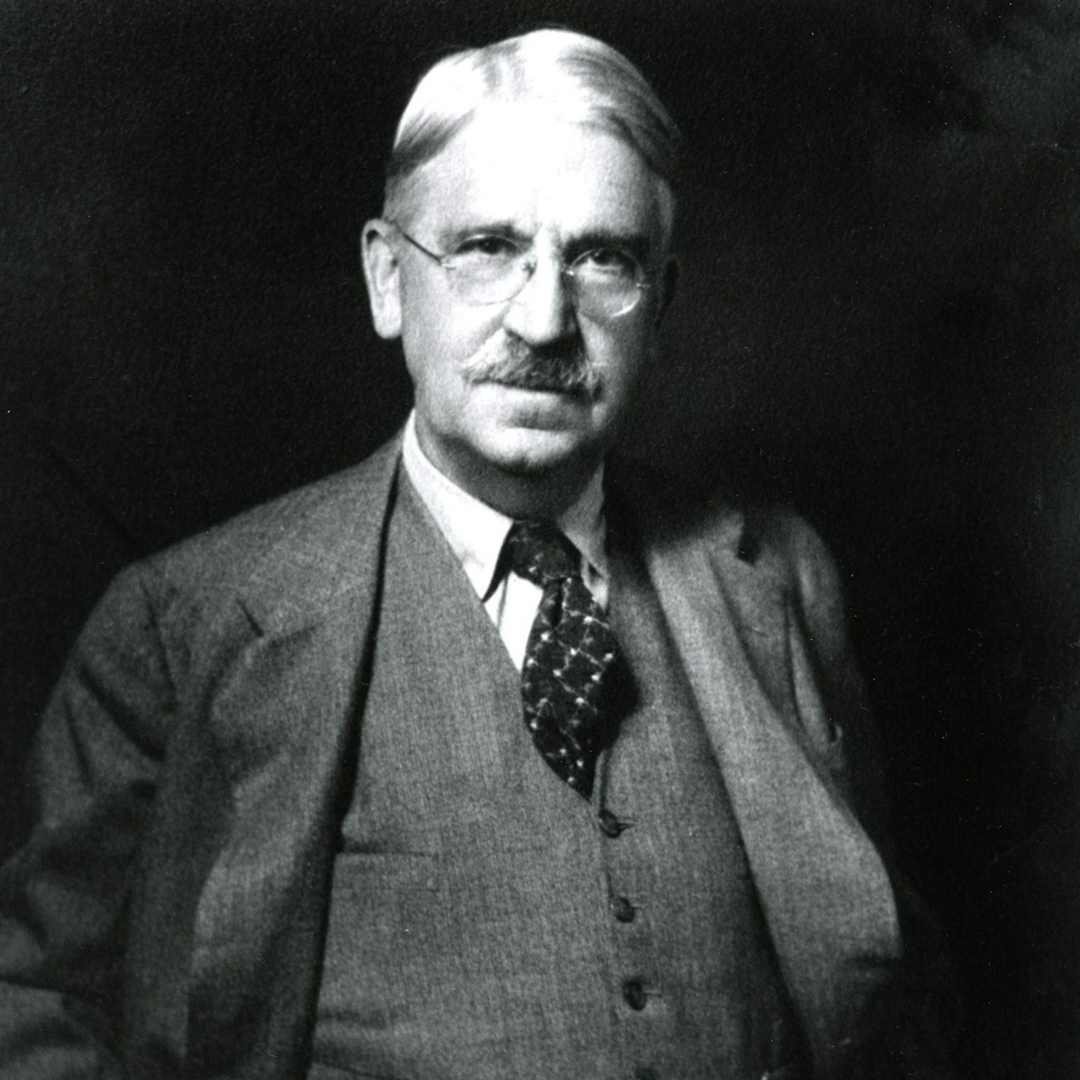
John Dewey (1859–1952) was an American philosopher, psychologist, and educational reformer who became one of the leading figures in the development of pragmatism. Building on the foundations established by Charles Sanders Peirce and William James, Dewey argued that knowledge emerges through experience, experimentation, and active inquiry. His writings on democracy, education, and social reform helped extend pragmatism beyond philosophy and into public life, making it one of the most influential intellectual movements in modern American thought.
Key Works by John Dewey
The Ethics of Democracy
Introduces the pragmatic maxim, arguing that the meaning of ideas lies in their practical effects and observable consequences.
Theories of Knowledge
Challenges several foundational assumptions in modern philosophy, particularly those associated with René Descartes.
Experience Nature and Art
Explores how individuals form and maintain beliefs, and why some methods of belief formation are more reliable than others.
The Need for a Recovery of Philosophy
Clarifies his original formulation of pragmatism, distinguishing it from popular interpretations that had diverged from his intent.
John Dewey and Pragmatism
John Dewey was one of the most influential figures in the development of American pragmatism, expanding the movement beyond abstract philosophy and into education, politics, ethics, and public life. Trained in philosophy and psychology, Dewey viewed thought as an active process rooted in experience, arguing that ideas should be understood as tools for solving practical human problems.
In works such as Theories of Knowledge, The Need for a Recovery of Philosophy, and Experience, Nature and Art, Dewey argued that knowledge emerges through inquiry, experimentation, and interaction with the environment. He rejected rigid divisions between mind and world, theory and practice, emphasizing instead the continuity of experience and the importance of adapting ideas to changing conditions. Dewey also believed that philosophy should address real social and political concerns rather than remain confined to abstract speculation.
Building on the foundations established by Charles Sanders Peirce and William James, Dewey helped transform pragmatism into a broader philosophy of democracy, education, and social reform. His work profoundly influenced modern educational theory, democratic thought, and the role of inquiry in public life, making pragmatism one of the defining traditions in American philosophy.
Key Ideas of John Dewey
Experience as the Foundation of Knowledge
Dewey argued that knowledge emerges through lived experience and interaction with the environment rather than through abstract reasoning alone.
Inquiry and Experimental Thinking
For Dewey, inquiry is an active process of problem-solving in which ideas are tested, revised, and improved through experimentation and reflection.
Democracy as a Way of Life
Dewey believed democracy was more than a political system. It was a social and ethical ideal grounded in participation, communication, and shared inquiry.
Education Through Experience
Dewey rejected rote memorization and passive learning, arguing that education should be rooted in activity, curiosity, and real-world experience.
The Continuity of Mind and World
Dewey opposed rigid divisions between thought and action, mind and body, or individual and society, emphasizing the interconnected nature of human experience.
Philosophy as Social Practice
Dewey believed philosophy should address practical human problems and contribute to the improvement of society rather than remain purely theoretical or abstract.
Influence on American Pragmatism
John Dewey played a central role in transforming American pragmatism from a philosophical method into one of the most influential movements in modern American thought. Building on the foundations established by Charles Sanders Peirce and popularized by William James, Dewey expanded pragmatism into education, democracy, ethics, and social reform. His work helped shift pragmatism from an abstract philosophical tradition into a practical framework for understanding how individuals and societies solve problems through experience and inquiry.
Dewey shared Peirce’s emphasis on inquiry, experimentation, and the practical consequences of ideas, but he placed greater focus on the social and institutional dimensions of human life. Like James, he rejected rigid philosophical systems detached from lived experience, arguing instead that knowledge develops through active engagement with the world. Through works such as The Need for a Recovery of Philosophy and Experience, Nature and Art, Dewey argued that philosophy should address real human concerns rather than remain confined to abstract speculation.
Dewey’s influence was especially significant in the philosophy of education. He argued that learning should be rooted in experience, participation, and problem-solving rather than memorization or passive instruction. These ideas reshaped modern educational theory and continue to influence debates about democratic education and experiential learning. His understanding of democracy as a form of shared inquiry also connected closely with thinkers such as Jane Addams and George Herbert Mead, who applied pragmatist principles to ethics, communication, and social life.
Beyond education and philosophy, Dewey’s work influenced psychology, political theory, public administration, and progressive reform movements throughout the twentieth century. His emphasis on experimentation, adaptability, and collaborative problem-solving helped establish pragmatism as a distinctly American approach to philosophy and public life. Today, Dewey remains one of the most widely studied pragmatist thinkers, and his work continues to shape discussions about democracy, education, experience, and the role of inquiry in modern society.